7th GRADE SCIENCE : Article 20 : Ending Forces lesson 1. Final and review.
* Activity 1.34 : Force lesson 1. Reviews. ( 10/23/17 Monday )
* Activity 1.29 : Reviewing balanced forces and Newtons laws. ( 10/16/17 Monday )
* Activity 1.24 : Reviewing Newtons laws. ( 10/9/17 Monday )
* Activity 1.27 : Summarising Newtons laws. ( 10/12/17 Thursday )
* Activity 1.28 : Balanced forces. ( 10/13/17 Friday )
NEWTONS LAWS.
* Activity 1.21 : How a plane flies and forces involved. ( 10/2/17 Monday )
1.21.c Reaction force search word. ( 10 points ).
* Activity 1.22 : First contact to Newtons laws. ( 10/3/17 Tuesday )
- Once you have looked this link up, answer the following questions :
- Who was Isaac Newton?.
- When did he live? Which century?. Where?.
- What did he do?.
- How many motion laws did he sketch out?.
- What kind of scientist he was?.
- What another issues about science did he do?.
- What is the first Newtons law?.
- Tell a situation or example in which the first law is involved.
* Activity 1.23 : Second Newtons law (Motion). ( 10/4/17 Wednesday )
a2) Write and explain what the second Newtons law says about forces and motion.
b) What is the mathematical equation for the second Newtons law?.
c) Tell an example in which the second Newtons law is involved.
d) Look this example (car) up, later do the following similar exercise at your workbook:
Mikes car, which weighs 2,000 kg, is out of gas. Mike is trying to push the car to a gas station, and he makes the car go 0.1 m/s/s. Using Newtons Second Law, you can compute how much force Mike is applying to the car.
1.23.b Go to the following LINK and summarize , using your own words, the most important that is said about the second Newtons law. ( 5 points ).
1.23.c At the following LINK you can make a test and check what you know about the second Newtons law after having done these activities. ( 5 points ).
* Activity : No school today. ( 10/5/17 Thursday )
NO SCHOOL.
* Activity : No school today. ( 10/6/17 Friday )
NO SCHOOL.
NET FORCES.
* Activity 1.16 : Reviewing Hooke´s Law graphs. ( 9/25/17 Monday )
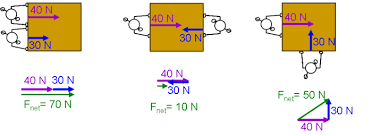
* Activity 1.17 : Net forces. ( 9/26/17 Tuesday )
1.17.b NET FORCES activity. ( 10 points ).
1.17.c Word search reviewing. ( 5 points ).
* Activity 1.18 : Reaction Force. ( 9/27/17 Wednesday )
Reaction force car report. ( 10 points ).
* Activity 1.19 : Net Forces booklet. ( 9/28/17 Thursday )
* Activity 1.20 : Finishing net force´s booklet. ( 9/29/17 Friday )
( 1.19.a ) Finishing task from yesterday ------ Net Force booklet.
Forces and measuraments.
* Activity 1.13 : Forces units and measuraments. ( 9/18/17 Monday )
MALIEKS WORK ( Click here and download a pdf with your work for today Monday ).
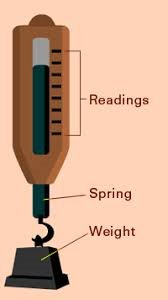
You already know that forces are measured in NEWTONS. But today we are using the appropriate device to measure forces, like weight, using the DYNAMOMETER. It is like a spring with a scale given in newtons in which we can measure different objects weights. The more the object weights the more the spring inside stretches and more newtons are given onto the scale.
1.13.a.1 Data table for dynamometers. ( 10 points ).
Students use different kinds of dynamometers to weight several different amount of objects with different weights. They have dynamometers in grams, in newtons and in kilograms at their reach. Once they weight the same objects as much in grams as in newtons they take notes about them at the paper given. They get used to read the different scales dynamometers show.
Dynamometers outline using rule, bag, etc.
Materials used in the experience.
( 9/19/17 Tuesday )
* Activity 1.13.a.2 to 1.13.a.4 : Dynamometer definition. Calculations. ( 5 points ).
MALIEKS WORK ( Click here and download a pdf with your work for today Tuesday ).
( Maliek, whatch the video in 1.13.a.3 and do the summarize or outline about it. Do nothing else ).
1.13.a.2 Dynamometer marbles weight. ( 5 points ).
1.13.a.3 DYNAMOMETER VIDEO.
( 9/20/17 Wednesday )
MALIEKS WORK (Click here and download a pdf with your work for today Wednesday ).
Please Maliek, read the pdf with the text about Hookes law and do a little summarize of it at your workbook. After that look up for information about who Robert Hooke was and did because he is the scientist who did the Hookes law in 1660.
+ INFORMATION ABOUT HOOKES LAW AND DYNAMOMETERS : Copy the following information about Hookes law given in PICTURE 1 at your workbook :
1.13.a.4 WHAT A DYNAMOMETER IS. ( 5 points ).
1.15 We work today in the computer room 217.
Follow the instructions given by your teacher in order to do your work at the computer. ( 20 points ).
* First of all copy the following learning targets at your workbook in order to understand what you are going to learn today in class :
LEARNING TARGETS FOR TODAYS LESSON.
* Consult the following links in order to answer the following QUESTIONS :
LINK 4 ( Nice Hookes law simulator, try it!! )
( At this simulator you can try with different values of the spring constant K in order to make the spring thicker or thinner and make it stronger or weaker and check how much it stretches when a force is applied ).
- If you have enough more time do a powerpoint presentation telling about Hookes Law, what it is, what it represents, what it talks about springs, about the Hookes law graph, and talking something about who Robert Hooke was. A general presentation about the Hookes law issue.
VECTORIAL AND ESCALAR MAGNITUDES.
* Activity 1.11 : Vectorial and scalar magnitudes. ( 9/8/17 Friday )
1.11.a Studying scalar and vectorial magnitudes : ( 10 points ).
Magnitude is every property that can be messured, like speed, weight, acceleration, mass, density, electrical conductivity, velocity, force, capacity, volum, etc.
- Some magnitude only need a number or quantity to be defined like the capacity and volum a bottle has, like 30 oz, or 2 liters, etc.
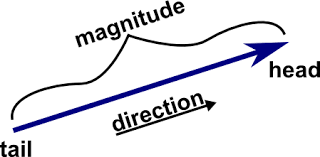
- Another magnitudes, like forces, velocity, etc, need both a number and a direction or vector, because they need to be determined by a direction. We must indicate in which direction, using an arrow, it goes. For instance the velocity and acceleracion a car is having need a vector, but the speed does not because speed is only a number.
1.11.b Speed and velocity ( 5 points ) : ( 9/11/17 Monday )
1.11.b.1 Reviewing test about vectorial and scalar magnitudes. ( 5 points ).
Vectorial and scalar magnitudes outline picture on the whiteboard.
( 9/12/17 Tuesday )
1.11.b.2 Finishing drawings from yesterday. Test-learning activity with the whole group about forces and vectors. ( 5 points ).
( 9/13/17 Wednesday )
1.11.b.3 - Difference between speed ( scalar magnitude ) and velocity , force ( vectorial magnitudes ).
Copy the following outline in your workbook in order to check the difference between the scalar variable of speed and the vectorial one of velocity :
Outline picture from whiteboard about speed and velocity.
Speed has no direction while velocity does. For example, if I say that Im running at 10 mph, I have given you my speed. If I say that Im running 10 mph north, then I have given you my velocity.
The short answer is that velocity is the speed with a direction, while speed does not have a direction. Speed is a scalar quantity -- it is the magnitude of the velocity. Speed is measured in units of distance divided by time, e.g. miles per hour, feet per second, meters per second, etc.
( 9/14/17 Thursday )
1.11.b.3.2 Make the following drawings at your workbook and indicate the forces the cars are doing, their vectors, directions, speed and velocities vectors : ( 10 points ).
TRUE OR FALSE ABOUT FORCES AND SPEED ? : ( 5 points each ).
Pointing out the parts of a force activity.
1.11.c Forces, vectorial magnitude. Parts of a force ( 10 points ).
1.11.c.1 Therefore we can say that velocity is a vectorial magnitude and speed is a scalar magnitude. The same about forces, when a force is indicated a vector (arrow) is needed as well as the number or value, so a force is a vectorial magnitude.
( 5 points )
FORCES ARE MEASURED IN NEWTONS, THAT IS THE UNIT OF A FORCE, AND IT IS MEASURED WITH A DYNAMOMETER.
A dynamometer or "dyno" for short, is a device for measuring forces.
1.11.c.2 - Parts of a force : ( 5 points ).
- Exercises about vectors, forces and forces vector parts :
( 9/15/17 Friday )
National geographic magazines.
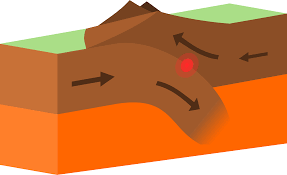
* Activity 1.10 : Showing Tectonic plates. ( 9/7/17 Thursday )
Your work should look like THIS .
1.10.b Searchword tectonic plates activity. ( 5 points ).
1.10.c Matching activity about tectonic plates. ( 5 points ).
Match each concept with the right definition.