Blogia

EASYFISQUIM , ESO i Batxillerat.

4ESO FQ English 2018-2019. Unit 3 DYNAMICS (FORCES). Article 5.
4ESO FQ English 2018-2019. Unit 3 DYNAMICS (FORCES). Article 5.


                                                 DYNAMICS.

        - You already know what Dynamic is from what you studied before about forces lesson. But you have anyway a reminder here :

        + Dynamics, branch of physical science and subdivision of mechanics that is concerned with the motion of material objects in relation to the physical factors that affect them: force, mass, momentum, energy. Newton’s laws of motion are directly related to Dynamics and, even more, they explain it.


       - MASS AND WEIGHT :


* Activity 1.32  :   Gravity and weight.                                          ( Monday )


           * WEIGHT and mass pic, page 61.


           *   These are the questions to answer  looking up the following links :


                                                               Gravity on whiteboard.


               1.32.a   GRAVITY, MASS AND WEIGHT. ( slides )                                                          


               1.32.b   MASS AND WEIGHT.     (hyperphysics website with definitions and equations).


               1.32.c   GRAVITY.  

                             Check your weight on other planets.

 
                             Here you can work out mass, gravity or weight.


                              Gravity in action on Pumpkins.


                                       When you finish answering all the questions.           ( 20 points ).


         + Do this PROBLEM about finding Jupiter’s gravity from knowing a person’s mass and his/her weight.


         * Page 68 Gravitation.

         * Page 68 Earth planet gravitation big size pic.

         * Page 68 Text about universal gravitation ( Newton’s equation ).


         > When attraction between Earth and an object is considered, Newton’s gravitation equation becomes like this :

                                                              Newton’s gravitation equation with Earth mass


         + NEWTON’S GRAVITATION EQUATION PROBLEMS.       Just try them !!


         + Here you have a problem about Gravitational attraction force  ( wording pic and then a solution pic ) in
            which one you have to solve for another variable different from the attraction force F.


                                                                        Problem wording

                                                                        Problem solution


         + At the following website you can check all whatever you want about GRAVITATION !!   ( Kepler’s laws included ).


          + VIDEO 1  easy explained the 3 Kepler’s laws.
          + VIDEO 2   easy explained the 3 Kepler’s laws.
          + VIDEO 3  easy explained the 3 Kepler’s laws.
          + VIDEO 4  easy explained the 3 Kepler’s laws.
          + VIDEO 5  even one more video explaining Kepler’s laws.
          + Right  HERE  you can find a page with an easy way to learn and understand   Kepler’s laws.

           + Let’s try now the exercises 1 and 3 from the following website about Kepler’s laws.
          + Let’s try a few more problems about solving and using Keple’s laws.


* Activity 1.34  :   Reviewing Mass and gravity.                                          ( Monday )


  1.34.a   Pics of earth, gravity and weight to make the poster.         ( 10 points ).


  1.34.c   Fun way to review forces.              ( 5 points ).
                           
                           Copy this outline on a sheet in order to review some of the forces studied.


  LINK 2  ( Weight , mass , gravity ).


* Activity 1.33  :   Gravity and weight test.                                     ( Tuesday )


                               GRAVITY , MASS AND WEIGHT TEST.                                ( 10  points ).


                                                                    Newton’s laws quizzes.


          *  Page 69 Dynamics summary.


          *  Page 73 GPS text and activity.


      -  Gravity text to be worked on class :  Page 1   Page 2   Page 3   Page 4


      -  Gravity cards for a talking activity : 

          
                                                   Pic 1 Questions 1 to 6  

                                                   Pic 2 Questions 7 to 12
                             
                                                   Pic 3  Answers 1 to 6

                                                   Pic 4   Answers 7 to 12


                                                   Questions cards pic 1
                                                   Questions cards pic 2
                                                   Questions cards pic 3
                                                   Answers cards pic 1
                                                   Answers cards pic 2
                                                   Answers cards pic 3


   - INCLINED PLANE ( advanced extra class ) :


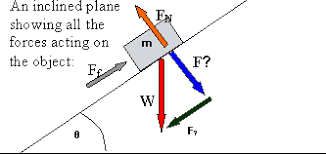
          - An inclined plane, also known as a ramp, is a flat supporting surface tilted at an angle, with one end higher than the other, used as an aid for raising or lowering a load. The inclined plane is one of the six classical simple machines defined by Renaissance scientists.

                   +  Video 1  Inclined plane.

                   +  Video 2 Inclined plane. Sine and cosine components.

                   +  Video 3  Inclined plane, sine and cosine components exercise example.

                   +  Video 4 Inclined planes and ramps.


          * Page 66 Inclined plane text and example. Working out Weight components.

          * Page 66 What slope is in a inclined plane and how to work it out.

          * Sine and cosine calculation. Page 66 inclined plane slope example.


          - Now it is time for you to achieve an exercise like that. Just try doing the 
            following exercise :


                    + Wording exercise 1

                       Find the components of a force F whose magnitude is 20 N and its direction is 
                          defined by angle θ = 30° made by the force and the positive x-axis as shown below.


                    + Wording exercise 2

                       Find the components of a force whose magnitude is 50 N and its direction is given by                           angle α = 25° made with the negative y-axis as shown in the diagram.


                    + You can find the solutions and explanations about the way to achieve 
                       them HERE.


                    + HERE   ,   You can find more exercises of the same kind.
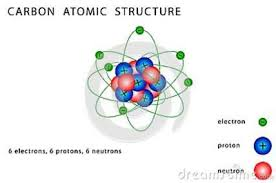


3ESO FQ 2018-2019 : Article 6 : ESTRUCTURA ATÒMICA DE LA MATÈRIA i LA TAULA PERIÒDICA DELS ELEMENTS. RADIOACTIVITAT, MARIE CURIE.

3ESO FQ 2018-2019 : Article 6 : ESTRUCTURA ATÒMICA DE LA MATÈRIA i LA TAULA PERIÒDICA DELS ELEMENTS. RADIOACTIVITAT, MARIE CURIE.


ESTRUCTURA ATÒMICA DE LA MATÈRIA i TAULA PERIÒDICA DELS ELEMENTS.


                 TAULA PERIÒDICA DELS ELEMENTS PER CONSULTAR.


       Sessió 1.  Què és un àtom, les seves parts, nucli, mida, partícules que té.

    * Aquestes són les activitats que cal que feu avuí a classe per aconseguir el TIC
      d’avuí :


    - Què és un àtom i per què és important en la materia ? Mira aquest VIDEO.

          + Ara llegeix la página 84 del teu llibre i contesta les següents preguntes a la
             teva llibreta :

                1) Què és un àtom?
                2) De què està constituïda la materia?.
                3) Qui va ser Demòcrit?.
                4) I qui era Dalton?.
                5) Quan es va descobrir l’electró?.
                6) Què són partícules subatòmiques?.
                7) Què és un picòmetre?.
                8) Quin és el diàmetre d’un àtom d’hidrogen?.

          + Fes un dibuix gran a la teva llibreta de l’esquema de les parts d’un àtom que
             trobaràs a la página 85 del teu llibre.


          + Per últim avuí fes l’exercici 1 de la página 84 del teu llibre.
             Al final de la página 84 tens fet un exemple de com fer exactament aquest
             exercici 1.


        Sessió 2. Detecció de diferents àtoms, color a la flama, estructura àtom,
                         quarks, microscopi efecte túnel, models atòmics.

     - Pràctica per a detectar diferents àtoms i elements presents i per tant detectar la 
       presencia de diferents estructures atòmiques :

           +  Consulta la següent WEB per a veure la pràctica que tracta del diferent color
               que té una flama segons el compost que es posa a sobre de la flama, i per 
               tant podem detectar diferents elements o àtoms presents en la mostra.


           +  Aquí tens un video 1 en el qual pots veure el diferent color a la flama que
               produeixen diferents elements alcalins.


           +  Aquí tens un video 2 en el qual pots veure el diferent color de flama que 
               produeixen diferents elements alcalins.


           +  Una vegada hagis vist els videos, fes una taula on classifiquis els diferents 
               elements segons el color de flama que produeixen.
                   Aquí tens un resum de la taula que s’ha fet a la pissarra de clase amb
                   els elements i el color que tenen quan es posen a sota d’una flama :

                                    PISSARRA METALLS I COLORS FLAMA


      -  Després de fer la primera activitat, fes el següent :

           +  Fes els exercicis 2,3,4,5 i 7 de la  página 85
 
           +  Fes l’exercici 8 de la página 86 i llegeix per suposat la página 86 primer.


        Sessió 2a. Taula periòdica dels elements, website per a practicar.

            
              + Aquí tens una taula periòdica on pots practicar els noms, símbols i
               famílies d’elements de la taula periòdica :

   
                                                   TAULA PERIÒDICA DELS ELEMENTS.


        Sessió 3. Nombre atòmic, símbols dels elements, ordenació de la taula
                        periòdica per nombre atómic. Diferències entre àtoms (Z).


      -  Activitat 1 : Mira aquests VIDEO 1 i VIDEO 2 ,a continuación fes l’activitat 2.


      - Activitat 2 : Llegeix la página 87 i la página 88 del teu llibre i després contesta a 
                            les següents preguntes ( mira amb atenció aquesta FOTO ) :

            a) Que és el nombre atòmic Z ?.
            b) Quina és la diferencia fonamental entre els àtoms de la taula periòdica?.
            c) Com s’ordenen els elements a la taula periòdica dels elements?.
            d) Què són els protons i on es troben?.
            e) Què és un isòtop?.
            f) Què és el nombre màssic i quina diferencia hi ha amb el nombre atòmic?.


      - Activitat 3 : Omple les dades dels elements que apareixen a la taula periòdica 
                             de la fotocòpia que et dóna el professor indicant el símbol de 
                             l’element, el nombre atòmic Z i el nombre d’electrons que té 
                             l’element al voltant del nucli.


                            FOTOCÒPIA DE LA TAULA PERIÒDICA QUE HAS DE TREBALLAR 


         Sessió 4. Nombre atòmic Z i nombre de massa A. Símbols i isòtops.
                                             Massa atómica relativa.

     
* Aquestes són les activitats que cal que feu avuí a classe per aconseguir el TIC
      d’avuí :


      Activitat 1 :   Després de llegir la página 88 del teu llibre, contesta aquestes
                                preguntes al teu quadern :

                                a) Què és un isòtop?
                                b) Quina diferència hi ha entre un element i un isòtop?


       - Activitat 2 :    Llegeix les pàgines 88, 89 i 90 del teu llibre i després fes al teu
                                quadern els exercicis de les pàgines 89 i 90.


         Sessió 5.  Activitat al laboratori. Dibuixar isòtops del Beril.li. 
                          Exercicis de fotocòpies de nombre màssic, atòmic, i calcular
                          nombre de protons, neutrons, electrons  i identificar 
                          elements a la taula periòdica.

     
 * Aquestes són les activitats que cal que feu avuí a classe per aconseguir el TIC
      d’avuí :


      -  Activitat 1 :   Observa aquesta fotocòpia i dibuixa els isòtops de l’element
                                Beril.li que es demanen. Hauràs de trobar primer el nombre
                                atòmic Z del Beril.li a la taula periòdica.


       - Activitat 2 :    Completa les preguntes i exercicis d’aquest dossier de fotocòpies
                                 sobre àtoms, elements, isòtops, nombre atòmic i màssic, etc.

                                                     Dossier isòtops pag 1
                                                     Dossier isòtops pag 2
                                                     Dossier isòtops pag 3


        - Aquí tens la foto dels posters dels isòtops de nitrogen de la pissarra :


                         POSTER 1                     POSTER 2                    POSTER 3 


        Sessió 6.   Revisió dels grups i períodes i families de la taula periòdica.
                          Radioactivitat i vida i treball de Marie Curie.


      -  Activitat 1 :  Llegeix les instruccions d’aquesta fotocòpia que et reparteix el
                              professor i dibuixa una taula periòdica rápida i indica en ella el
                              que es demana, metalls, grups, períodes, etc. Després contesta
                              les preguntes que hi ha a la página 2 de la fotocòpia.

                                               Pàgina  1                      Pàgina 2


      - Activitat 2 : Llegeix el text que hi ha en aquestes 3 pàgines de les fotocòpies
                            que et reparteix el professor sobre la Radioactivitat. Quan acabis,
                            contesta les preguntes que hi ha a la página 4 de les fotocòpies.

                                   Pàgina 1        Pàgina 2        Pàgina 3        Pàgina 4 


      - Activitat 3 : Llegeix el text que se’t proporciona en aquestes 3 pàgines de les
                            fotocòpies que et reparteix el professor. Després fes l’activitat que
                            apareix a la página 4 de les fotocòpies sobre fer un resum amb les
                            teves paraules sobre la vida i obra que has llegar de Marie Curie.

                                   Pàgina 1        Pàgina 2        Pàgina 3        Pàgina 4


          Sessió 7.   Activitats extra a treballar amb els següents textos del llibre.


      -  Activitat 1 :  Llegeix els següents textos de les pàgines del teu llibre i després
                              fes les activitats que t’indiqui el professor.


                                       Text 1  : Sobre les tempestes elèctriques.

                                       Text 2  : Sobre el mineral COLTAN.

                                       Text 3  : Sobre la determinació de la composició d’un mineral.

                                       Text 4  : Sobre la mina de coure més gran del món.


MATES 3ESO FLEX 3. Exercicis per a repassar per a l'examen del dilluns de la primera part del tema de polinomis.

MATES 3ESO FLEX 3.  Exercicis per a repassar per a l'examen del dilluns de la primera part del tema de polinomis.


                                          EXERCICIS PER A REPASSAR PER
                                                 L’EXAMEN DEL DILLUNS.
                                 ( Enunciats i solucions dels exercicis de polinomis ).


  + Enunciats dels exercicis per a repassar, pissarra 1 :     FOTO 1
   
  + Els altres enunciats de la pissarra 2 :                         FOTO 2

  + Solucions del exercicis de repàs :                              FOTO 3      FOTO 4

                                                                                  FOTO 5      FOTO 6    
                                     
                                                                                  FOTO 7


INTERESTING LINKS : Article 1

INTERESTING LINKS :  Article 1


                                                              LINKS.

 1. FORCES:

     Video in english about a parallel multiforce system and how to find out the net
     resultant forcé.


 2. FORCES :

     Website with high level exercises about parallel multiforce systems with solutions.
     University level. Website in english.

 3. FORCES :

     Website in spanish explaining very well an example of two unlike parallel forces and
     the way to work out the resultant force and the right point where it is placed.

 4. Maths 3ESO Polynomials :

     Website with polynomial explanations and exercises.  ( edu365.cat )

5. WORK AND RESISTIVE OR AIR RESISTANCE FORCE:

    YouTube video in english with a guy explaining how to work out problems having
    work, forces, friction, energy, velocity and acceleration involved.


 6. Forces : inclines, friction forces, components, angles, 2nd newton law problems.

     2nd Newton’s law problems with horizontal tables, with inclines, and very well 
     explained using vectors, angles, friction forces, tensions, drawing vectors. 
     It is almost 12th grade physics level but it is a nice website to check.


 7. Chemistry 1st and 2nd Batxillerat:

          a)  Website 1
          b)  Website 2
          c)  Website 3
          d)  Website 4
          e)  Website 5
          f)   Website 6 (1r Batx )
          g)  Website 7  a lot of resources (1st and 2nd batx)
          h)  Website 8 ( Anaya solucionari 1st and 2batx , etc )
          i)   Excel.lent web chemistry in context 1st and 2nd batx. (xtec).
          j)   Laboratori virtual al aula, batx. Article per llegir i anar al enllaç.
          k)  Website with huge number of links to any acid-base issue and others.
          l)   Moodle website from Institut Cendrassos with all lessons 2nd Batx.
          m) Website IES Badalona VII with all lessons.
          n)  Xtec exemples experiències laboratori diferents temes 2n batx química.
          ñ)  Pràctiques de laboratori per a 2nd batx.
          o)  Material varios temas IES alcobendas 2nd batx química.
          p)  Amazing website for 1st batx physics and chemistry with huge nice well
               designed material.
          q) 2nd batx experiences. Gravimetric clorur analysis and acid-base valoration.


  8. Números complejos2 nice videos ( part 1 and part 2 about an old experienced  
                                   teacher from Argentina explaining basic issues about  
                                     complex numbers.


  9. Molar mass work out from atomic mass values, estequiometric calculations.
      Nice website where it is all explained with big nice photos and easy examples
      accordint to 1rs batxillerat grade (11th grade chemistry ). (web in spanish).


 10. Gasos exercises websites:

            Link 1     to get exercises and examples about gases problems.
            Link 2     "
            Link 3     "

  11. 1r Batx fine Chemistry material from IES Badalona VII :   LINK  


  12. 2n Batx Chemistry material from IES Baix a mar :   LINK  


  13. 2n ,1r ,4ESO , 2ESO ,etc Chemistry and physics materials from IES Maria
        Aurèlia Campany  :    LINK  

        * 4ESO FQ blog and lot of links to chemistry webs exercises and resources :  LINK
 
        * ESO website with nice easy experiments to be done 2ESO,3ESO :   LINK

        * ESO several salts solubility lab experiences (solubilitat amb la temp) :         LINK


  14.  Nice chemical experiments for ESO :   LINK 1     LINK 2      LINK 3 (energia hidrogen)


  15.  Very useful chemistry lessons from University Carlos III in a slide html way :   
       
                                                              LINK

  16. Amazing chemistry material 2n batxillerat, whole lesson plans (educa aragon) :  

                                                              LINK


  17. Nice slide xtec link about sort of chemical bonds :   LINK


  18. Xtec 2n batx chemistry in action ( chemistry within natural processes ) :   LINK


  19. PAU Chemistry and Physics exams and solutions from 2000 to 2019  :    LINK


  20. Experiments and calculations with calorimeter  (Cp i Cv ) :     LINK


  21. Kinetics experiments reports and instructions :     LINK


  22. Equilibrium complete slides :  LINK 1     LINK 2


  23. All lessons, files and solutions from 2nd batx chemistry IES Pius Font i Quer :  LINK
                                                         
  24. Very nice website for PRESSURE for ESO :    LINK


  25. Website with booklinks and transcripts about many 2nd batx chemical issues. In 
        this case about how to adjust and balance redox equations :    LINK 1   LINK 2

  26. Bunch info in catalan iES Ramon Berenguer IV about acid-base neutralizations 
       and volumetrics :   LINK

  27. Nice webs for ESO’s solution subject  :  LINK 1  (slides)    LINK 2


  28. Incredible "solucionario" physics and chemistry university level with more than
        2000 pages in slides.         LINK

  29. Nice quick web to compress videos with less Mb and make them weigh less : link

  30. Very nice blog for FQ all ESO grades , with activities :  blog

  31. Chemistry simulations Phet :   web

  32.  Phet simulations science : web

  33.  ChemEd DL , nice web with resources and 3D molecules models you can
         choose and move and see how atoms connect to each other. All composts you
         want to find just writing the name in the searching bar.    Web

  34. Química en context-blog del departament amb aplicacions de la química a la
        vida quotidiana per estudiar i explicar el temari de 2nd batx química: web

  35. Buen portar de química con datos prácticos y ejemplos de moléculas : Link

        Y que tiene buenos enlaces a otras webs de química como por ejempla esta
        que está muy bien como temario de química en inglés :   Link

  36. Muy buen blog con muchos muchos recursos para 4ESO y más :   Blog

  37. Blog con ejers y material, ok , de mates y FQ de eso y batx :  Blog

  38. Webs para earth and space science : 


3ESO FQ 2018-2019 : Article 5 : MESCLES I SOLUCIONS.

3ESO FQ 2018-2019 : Article 5 :  MESCLES I SOLUCIONS.


                                        MESCLES I SOLUCIONS.


     -        Video mescles homogènies.              Video mescles heterogènies. 


     - Primer observa aquestes diapositives que expliquen què és matèria homogènia i 
       heterogènia i observa els exemples.

                                                        DIAPOSITIVES


     - Si vols saber-ne molt més i amb molta més profunditat i detall, consulta aquest 
       repertori de diapositives i podras saber tot ho relacionat amb mescles i solucions.

                                           DIAPOSITIVES EN PROFUNDITAT


      - Observa ara aquestes darreres diapositives per a estudiar la diferència entre 
        substàncies pures ( elements i compostos), mescles homogènies o dissolucions i
        mescles heterogènies. Pot consultar aquí també les diferents tècniques que 
        s’empren per a la separació de mescles.


                                    DIAPOSITIVES SEPARACIÓ DE MESCLES


     - Observa aquesta IMATGE que explica molt bé el que passa en un procès de  
       dissolució.


     - Pràctica : Materia homogènia i heterogènia. Diferenciació. Preparació de mescles.
                       Separació de mescles homogènies i heterogènies.


          FOTO PISSARRA DIFERÈNCIA MESCLA HOMOGÈNIA I HETEROGÈNIA.


         FOTO PISSARRA PRÀCTICA MESCLES HOMOGÈNIES I HETEROGÈNIES.


   1- Foto alumnes 1 lab , pràctica preparació mescles homogènies i heterogènies.
     ( Els alumnes barregen aigua i sal durant el procès de dissolució per a crear una
        mescla homogènia o solución ).

    2- Foto alumnes 2 lab , pràctica preparació mescles homogènies i heterogènies.
      ( Després de barrejar durant el procès de dissolució, una vegada la mescla feta
        s’ha obtingut la solución o mescla homogènia d’aigua i sal ).

    3- Foto alumnes 3 lab , pràctica preparació mescles homogènies i heterogènies.
      ( Els alumnes comparen la mescla heterogènia obtinguda de farina i aigua amb
        la homogènia obtinguda al barrejar sucre i aigua ).

    4- Foto alumnes 4 lab , pràctica preparació mescles homogènies i heterogènies.
      ( Els alumnes comparen dues mescles heterogènies obtingudes al barrejar molt
        de sucre amb aigua i altra al barrejar molt de bicarbonat de sodi amb aigua ).

    5- Foto alumnes 5 lab , pràctica preparació mescles homogènies i heterogènies.
      ( Els alumnes fan dues solucions o mescles homogènies, una de sòlid amb líquid 
        barrejant sal en aigua, i altra amd dos líquids barrejant vinagre amb aigua ).

    6- Foto alumnes 6 lab , pràctica preparació mescles homogènies i heterogènies.
      ( Els alumnes comparen mescla homogènia de líquids o líquids miscibles de
        alcohol amb aigua amb una mescla heterogènia de líquids o líquids inmiscibles ).


       - Formes d’expressar la concentració d’una solución o mescla homogènia :


                            FOTO PISSARRA CONCENTRACIÓ SOLUCIONS


                                        Foto 1 llibre concentració solucions.

                                        Foto 2 llibre concentració solucions.


        - Primers exercicis de concentració de solucions : ex 17,18,19,20 i 21.

                                               Foto enunciats ex 17,18,19
                                               Foto enunciats ex 20,21


         - Aquestes són les tasques que cal fer avuí sobre concentració de solucions :
 
                                                         Mirel la FOTO.

 
         - Enunciats dels exercicis del 11 al 14 pag 65 sobre solucions : FOTO

         - Solució exercici 11 : FOTO

         - Solució exercicis 12 al 14 : FOTO


         - Exercici del gràfic d’elements més abundants a l’escorça terrestre : FOTO


         - Examens resolts d’altres anys sobre problemas de solucions :  LINK

         - Problemes més senzills sobre càlcul de concentració de solucions :  LINK

         - Problemes numèrics més complexos sobre el càlcul de concentració de 
           solucions :
                                                                 LINK

          - Aquí tens el full que us he repartit amb els 10 problemes que cal fer
            sobre el càlcul de concentracions de les solucions :   FOTO

            I aquí teniu els problemes resolts i amb les solucions per comprobar si
            els heu fet correctament i perquè els estudieu :   PDF problemes resolts


          + Examen resolt que haveu tingut sobre problemes de solucions :

                                                    Foto Enunciats            

                                                  Foto examen resolt 


  -PRÀCTICA DE COM PREPARAR UNA SOLUCIÓ DE CONCENTRACIÓ EXACTA 
              I CONEGUDA AMB LA UTILITZACIÓ D’UN MATRAÇ AFORAT.


       Full d’explicació i instruccions de com preparar la solución i fer servir el matraç

      INSTRUCCIONS PER A LA PRÀCTICA DE PREPARACIÓ D’UNA SOLUCIÓ.
                         ( com preparar una solución de concentració coneguda )

             FOTO 1 :  Alumes pessant 3g de solut (NaCl , sal comuna)
             FOTO 2 :  Alumnes afegint al matraç aforat la preparació de dissolució 
                              de la sal en aigua.
             FOTO 3 : Alumnes aforant el matraç de 100ml amb el comptagotes per 
                             obtener una solución de concentració coneguda de 0,03g/ml


         - SUBSTÀNCIES INSOLUBLES I LÍQUIDS MISCIBLES I SUBSTÀNCIES 
                                INSOLUBLES I LÍQUIDS IMMISCIBLES.

   
                                 Foto text explicació solubilitat substàncies


             Foto 1 substàncies solubles                                Foto 2 líquids miscibles

             Foto 3 substàncies insolubles                             Foto 4 líquids immiscibles


          - SOLUCIONS SATURADES :

             Foto text explicació solucions saturades.

             Foto concepte solubilitat explicació.

             Foto gràfica solubilitat i saturació amb dades de diferents substàncies.

             Foto amb només la gràfica per parlar-ne a classe abans de fer els exercicis.

             Foto amb problemes a fer sobre solubilitat i solucions saturades.


          + Tècniques de separació de mescles : FOTO esquema pissarra.

                                        * FOTO DECANTACIÓ
                                        * FOTO EMBUT DECANTACIÓ
                                        * FOTO FILTRACIÓ
                                        * FOTO DESTIL.LACIÓ
                                        * FOTO CRISTAL.LITZACIÓ
                                        * FOTO IMANACIÓ
                                        * FOTO RESUM TÈCNIQUES SEPARACIÓ
                                        * FOTO RESUM TEMA SOLUCIONS


           + Videos tècniques de separació de mescles :

                    * Video 1 sobre les principals tècniques de separació de mescles:

                       FILTRACIÓ, DECANTACIÓ, DESTIL.LACIÓ, IMANACIÓ 
                       (MAGNETISME), EMBUT DE DECANTACIÓ, CROMATOGRAFIA, etc.


                    * Video 2 sobre les principals tècniques de separació.

                       
                    * Video 3 sobre les tècniques de separació de mescles.


           + Textos finals del tema per llegar i veure les aplicacions que tenen les solucions a la vida quotidiana i a la natura. Llegir els textos, resumir-los i contestar les preguntes suggerides:

                                              Text 1 :  ADOBS

                                              Text 2 :  CONSUM RESPONSABLE D’ALCOHOL

                                              Text 3 :  SEPARACIÓ DELS COMPONENTS D’UNA MESCLA.

                                              Text 4 :  L’ÀCID SULFÚRIC


            + Aquí teniu una foto de la pissarra amb la teoria que entra per a l’examen
               de teoria de solucions per la propera setmana pels grups 3B i 3D. El dimarts
               serà l’examen per 3D i el dimecres el tindrà el 3B :

                                                        FOTO PISSARRA


            + I aqui teniu el quadernet de repàs que us he fet amb el més important de
              teoria del tema de solucions per l’examen de teoria de la propera setmana :


                                                     QUADERNET EN PDF


4ESO FQ English 2018-2019. Unit 2 FORCES. Article 4.

4ESO FQ English 2018-2019. Unit 2 FORCES. Article 4.


     - Let’s check these first links in order to find out what a force is and which is the 
       best way to explain it by writting :


                                       a) FORCES AND DYNAMICS.

                                   b)  What is a force?.

                                      c) Forces for kids.

                      d) What a dynamometer is.


                                            e) Forces, motion and gravity.


     + Now, take your workbook and answer these questions using your own words:

                                1- What is a foce?

                                2- How can be forces measured?.

                                3- What is the connection between forces and acceleration?.


     - Scalars and vectors.

     - Vector parts.

     - Parts of a force vector.

     - Forces and its effects.


     > QUIZLET ACTIVITY 1 (Check what you’ve learnt).

     > QUIZLET ACTIVITY 2.

     > QUIZLET ACTIVITY 3.


     + Forces LINK 1 ( forces problems about concurrent and non concurrent forces )

     + Forces LINK 2 (examples of kind of forces )

     + Forces LINK 3 ( links to websites about forces, dynamics and kind of forces )

     + Forces LINK 4 ( normal force and equilibrium force )

     + Forces LINK 5 ( weight, mass and gravity force )

     + Forces LINK 6 ( friction force and video about Newton’s laws )

     + Forces LINK 7 (physicsclassroom website about the whole Forces lesson)


      - Forces, vectors and Newton’s laws worksheets and peer  talking assessment 
        rubric :


              Forces statements sheet 1              Forces statements sheet 2


              Talking about forces and vectors sheet 1
              Talking about forces and vectors sheet 2
              Talking about forces and vectors sheet 3
              Talking about forces and vectors sheet 4
              Talking about forces and vectors sheet 5
              Talking about forces and vectors sheet 6
              Talking about forces and vectors sheet 7
              Talking about forces and vectors sheet 8
              Talking about forces and vectors sheet 9
              Talking about forces and vectors sheet 10
              Talking about forces and vectors sheet 11
              Talking about forces and vectors sheet 12
              Talking about forces and vectors sheet 13
              Talking about forces and vectors sheet 14
              Talking about forces and vectors sheet 15
              Talking about forces and vectors sheet 16
              Talking about forces and vectors sheet 17
              Talking about forces and vectors sheet 18


               Forces-vectors talking activity cards 1
               Forces-vectors talking activity cards 2


               Vector’s part sheet 1
               Vector’s part sheet 2


               Peer talking assessment rubric


             - Concurrent forces :  LINK

                              In physics, concurrent forces are defined as forces that pass through a 
                             common point. In other words, a concurrent force system is a set of two or
                             more forces whose lines of action intersect at a point at the same time.

                          * Concurrent forces image example :     FOTO

                          * Concurrent forces Video example exercise :   VIDEO


                      * Net Force calculation on concurrent forces exercises with the 
                         same and opposite direction :   LINK  

                      * Concurrent forces exercises :  Page 1        Page 2
                         And the exercises solutions :   Page 3        Page 4

                       * Tug of war game, concurrent forces exercise example :  FOTO

                       * Parallelogram method to get net Force :  FOTO 1     FOTO 2

                       * Parallelogram method exercises 1 i 2 :  FOTO 1      FOTO 2

                       * Parallelogram method for balanced forces in equilibrium :  FOTO

                       * Concurrent forces ex1 : FOTO

                       * Concurrent forces ex3 : FOTO

                       * Concurrent forces SCALE ex5 : FOTO

                       * Exam from past year about concurrent and non concurrent forces :
                 
                                                                 FOTO

  (At the following pic you find the answers to the exercises from this exam) : LINK


                       * More complicated exercises examples related to concurrent forces
                          when involving coplanar ( 2-dimensional ) forces. Examples about
                          two tugboats towing a cargo ship (exercise 1) :    LINK


             - Non concurrent forces :  LINK

                        A couple is an example of a non-concurrent force because its 
                       line of action does not intersect at one point.

                            * Non concurrent forces image example :       FOTO

                       * This is a great link where you can find and learn a lot about
                          working out resultant net forces on non concurrent like and 
                          unlike parallel forces systems :   LINK

                          ** And here you can check it but in a pdf file :  PDF


 - What’s a TORQUE ?  A TORQUE is … ( read also this website )

 - Website with problems having a TORQUE  involved :  Website


 - You can follow a nice explanation video about NON CONCURRENT PARALLEL FORCES separated certain distance :


    > Parallel forces exercise with same sense.


   >  Parallel forces exercise with different sense.

        * At this link you can look up how to work out the resultant of of parallel coplanar forces :   LINK


         + And at this website you have a very clear explanation about an example of two unlike parallel forces
            exercise and how to find out the net resultant force and where its point of application is plot :

                                                                             WEBSITE


  -  After you’ve practiced and watched the different videos, try to do the following exercise by your own. Check previous videos as many times as you need to develope the exercise by yourself. In case you cannot achieve the problem’s solution you have the problem explained at the video below :


  > Exercise :

          A 15kg metal bar 6m long has two objects hanged at the opposite ends of the bar. At the left end of the bar hangs an 20kg object and at the right end of the bar the second 30kg object. Find where exactly the net force must be placed in order not to let the system fall. Work out the value of the net or balance force, the exact spot it must be placed, the direction and if it is like or unlike to the forces involved initially.


  > VIDEO WITH PROBLEM’S SOLUTION.


       + Now try by yourself the following exercises about non concurrent parallel forces:

                           Wording exercise 1 :   FOTO  ( like forces )
                           Solution exercise 1:     FOTO 

                           Wording exercise 2 :    FOTO( unlike forces )
                           Solution exercise 2 :    FOTO


       + Activity about first Newton’s law :  Watch these VIDEO1 and VIDEO2
                                                                      then do the following :


           a) What’s the first Newton’s law and what does it talk about? Write the answer
               down on your notebook. Make a Word file to do it if you prefer.

           b) Draw an outline or a design or an example in which you could explain the
               first Newton’s law is being applied.


        + Activity about second Newton’s law :  


            a) Read what this website has to say about second Newton’s law and
                summarize the most important at your notebook or on a Word file.

            b) Go to this SIMULATOR website and check how second Newton’s law
                can change objects’ motion.


        + Activity about third Newton’s law :  


           a) Read the text at the following LINK and write on your notebook what
               third Newton’s law is and what it says. You can achieve the activity on
               a Word file too if you prefer.

           b) Go to this LINK and give an answer to every example and draw the 
               action and reaction forces acting in each one.


         + NET FORCE and 2nd Newton’s law : Go to this link.

         + RESISTIVE OR FRICTION FORCE and 2nd Newton’s law : 
 
            Take a look at this LINK1 and later at this link2.

         + Next check this fantastic webpage about 2nd Newton’s law and all the main
            issues involved. You’ll find drawings, exercises, examples, definitions, it is
            just great!! , it also explains friction force with exemples :

                                      LUMEN PHYSICS 2nd NEWTON’S LAW.


         + NEWTONS’S LAWS GLIMPSE :   FOTO   ( text with gaps to fill out )


          + Specific ACTIVITIES ABOUT 2nd NEWTON’S LAW :


           * Steps to follow to work out 2nd Newton’s law problema with friction force
              involved. Check it to see how to figure out this kind of problems :  FOTO

           * 2nd Newton’s law leaflet with exercises to practice :   PDF

          + Solution of the 6 problems from the last leaflet about 2nd law : 

                                          FOTO 1     FOTO 2     FOTO 3


          * At this link you can find explanations, from easy ones to more complicated ones,
             about how to figure out resultant forces within different force systems. You can 
             also have there a wide variety of problems with solutions :   LINK
             ( At the end of that website you’ll find a link with problems ).


           + This is a nicely done webpage from BBC in order to revew Newton’s main
              three laws about motion. You have there explanations, exemples, videos,
              graphs, outlines, working out problems and much more. Just check it!! :

                                               BBC Newton’s laws review


           - HOOKE’s LAW :

          * What’s Hooke’s law? …………. Check these LINK 1 , LINK 2 and  LINK 3.
             + Whatch these videos now :  VIDEO 1   and   VIDEO 2  about Hooke’s law.


          * TASK TO DO :

                  Pay attention now to the following PIC and the related GRAPH showing a 
                  spring stretching and then answer the following questions and exercises.


                       + Question 1 : What’s happening at the PIC’s image?. Explain it and
                                               write it down.


                       + Question 2 : Imagine that each weight that is added at the PIC’s 
                                               image is about 7N. Write down the formula you should
                                               use you explain the Force the spring is doing. Afterwards
                                               figure out the spring stiffness constant using that formula 
                                               and the values of displacement and force that are  
                                               displayed at the PIC.


                       + Question 3 : Take a look again at this Hooke’s spring law GRAPH and
                                               find the spring stiffness constant and also the stretching
                                               spring will take when a force of 3N is applied.


                       + Question 4 :  Do exercise 2 from page 43.


           * Forces Lesson multiple choice TEST


            - Forces in Architecture :

           * Read  page 55  from your textbook about the importance forces have in
             Architecture and how they are spread out within the building structure.
 
                                                    Page 55 Big size pic

                                                               
                  + Look up this Link 1 and Link 2 about buttress ( contrafuertes ) in
                     architecture and the different ways that exist to spread out forces usind
                     different kind of buttress and flying buttress ( arbotante ).


                         + If you wanna know more about Gothic architecture : LINK


                   + TASK TO DO :

                      Once you have already checked, read and looked up all this material
                      and these websites, just make a presentation about explaining and 
                      showing how importants forces have been in architecture throughout
                      history and the methods and improvements that have been achieved
                      to make possible to buid bigger and greater buildings. You can make a
                      PowerPoint or just create your own file at your drive.


3ESO FQ 2018-2019 : Article 4 : CANVIS D'ESTAT.

3ESO FQ 2018-2019 : Article 4 :  CANVIS D'ESTAT.


                                              CANVIS D’ESTAT.


   - Canvis d’estat d’agregació de la matèria que anem a estudiar.


   - Què és un canvi d’estat?.


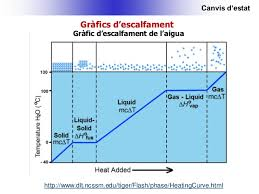
   - Gràfica d’escalfament d’una substància pura ( Canvis d’estat ) PISSARRA.


   - Experiment que hem fet al laboratori del canvi d’estat de VAPORITZACIÓ d’aigua
     pura i d’aigua amb sal. Mesurem com augmenta la temperatura a l’escalfar i com
     aquesta roman constant durant el canvi d’estat de líquid a gas. Després el proper
     dia construim la gràfica d’escalfament amb les dades obtenides per cada grup al
     mesurar les temperatures a cada minut. Fixeu-vos a les fotos com (segons la qua-
     litat del termòmetre emprat) l’aigua pura bull entorn als 100ºC mentres que l’aigua
     amb sal el termòmetre marca fins a 105ºC com a temperatura de canvi d’estat al
     principi, ja que després va canviat conforme es vaporitza l’aigua i es concentra més
     la sal, ja que no és una substància pura sinó una mescla.


           Foto 1     Foto 2     Foto 3     Foto 4     Foto 5     Foto 6     Foto 7     Foto 8

                                  Foto 9     Foto 10   Foto 11   Foto 12   Foto 13


                     Foto de la gràfica d’escalfament construïda a partir de les dades
                     de temperatures obtingudes al laboratori.

                                                                   FOTO


    - Pràctica de la sublimació del iode i de la sublimació inversa o regressiva fent servir
      un matraç amb gel :


                                Foto 1     Foto 2     Foto 3     Foto 4     Foto 5    
    
                                        Foto 6     Foto 7    Foto 8     Foto 9


                        +  Resum o informe de la pràctica a la pissarra :   FOTO


     - Pissarra amb els principals tipus de vaporitzacions : Evaporació i ebullició :


                        FOTO Pissarra :   Diferències entre evaporació i ebullició


     - Canvi de la temperatura d’ebullició d'un líquid pur amb l’altura i la pressió :  
( Cal veure el video i després escriure l'explicació que es dóna del perquè de l'experiment i procés ).


                                               Consulta aquesta Website.


       - Foto de l'esquema de la muntanya on la temperatura d’ebullició d'un líquid pur 
         canvia amb l'altura i per tant també amb la pressió: 


                                                              FOTO.


3ESO FQ 2018-2019 : Article 3 : Lleis dels gasos.

3ESO FQ 2018-2019 : Article 3 :  Lleis dels gasos.


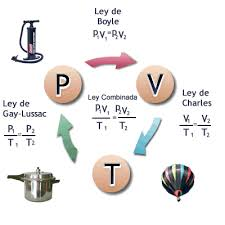
     - Consulta el següent link en relació a les lleis dels gasos de Boyle i Gay-Lussac :

     * Lleis dels gasos.


     - Aquí tens el quadre amb els resultats de l’experiment que vam fer amb la  
       xeringa per a comprovar la llei de Boyle dels gasos, i a continuació l’exercici 
       que vam fer a la pissarra :


       a) Quadre amb experiment xerinta de la llei de Boyle.

       b1) Enunciat de l’exercici de la  llei Boyle.         b2)  Exercici resolt.


     - Fes aquesta activitat sobre la llei de Boyle dels gasos i la relació que hi ha
       entre aquesta llei i la teoria cinèticomolecular que la explica.

       + Acitivitat llei de Boyle i teoria cinèticomolecular. 


       + Relació i connexió entre la teoria cinèticomoleular i la llei de Boyle escrita
          a la pissarra com a conclusió de l’activitat anterior :  PISSARRA.


       + Experiment pràctic per a comprovar la teoria cinèticomolecular fent servir
          la dissolució de colorant vermell tant en aigua freda com en calenta:
    
                                                                   FOTO

  
       + Aquí teniu l’informe que haveu fet sobre la pràctica anterior, on us vaig fer
          un petit resum a la pissarra. Us el deixo aquí perquè el pugueu repassar :

                                                                   FOTO


       + A continuación us deixo un PDF amb tot resumit sobre els estats 
          d’agregació de la matèria, la teoria cinèticomolecular, els canvis d’estat,
          propietats de sòlids, líquids i gasos, la lley de Boyle i Gay-Lussac i la llei
          general dels gasos, i la temperatura absoluta en kelvins, perquè pugueu  
          estudiar i repassar aquesta part del tema per l’examen.

                                                               PDF Gasos


        + Expliació de la teoría cinètica-molecular, amb preguntes contestades
           sobre què és, els seus postulats, i com explica els diferents estats 
           d’agregació i les seves propietats :

                                                            Pàgina 1                    Pàgina 2


        + Dossier de recuperació del tema 2 de Gasos :


           Pàgina 1          Pàgina 2          Pàgina 3          Pàgina 4          Pàgina 5